Reagent Provenance as Translational Control: The Antibody Validation Gap in UK Laboratories
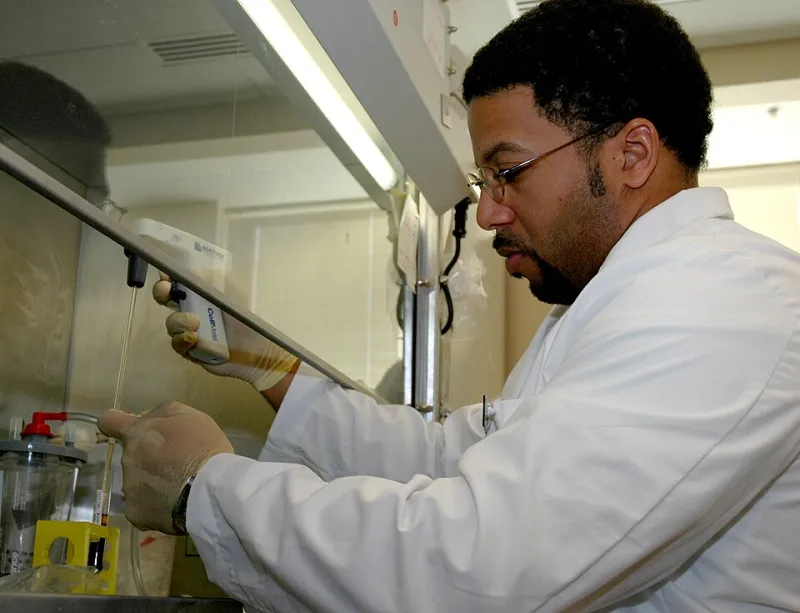
Photo: Diane A. Reid (Photographer), Public domain, via Wikimedia Commons
In UK laboratories, antibodies are often bought like consumables: a catalogue number, a quick price comparison and a place in the freezer. That framing is convenient, but it is analytically unsafe. An antibody is a critical reagent. Its binding behaviour, lot-to-lot consistency and fitness for a particular application determine whether an experiment produces evidence or merely a result. In 2026, with research budgets under pressure and translational timelines tight, the cost of treating antibodies casually is becoming harder to absorb.
The cost is not on the purchase order
An unvalidated antibody rarely fails immediately. It produces a band, a stain or a fluorescence shift that looks plausible. The failure surfaces later: a Western blot that cannot be repeated, an immunohistochemistry series with unexplained background, a flow panel that drifts between batches. By then, the laboratory has spent technician hours, sample material, instrument time and supervisory attention. In grant-funded work, the loss may appear as a missed milestone rather than a line in the reagent budget. In translational projects, it can weaken the evidence package that supports a partner review or a regulatory conversation.
The most expensive reagent is therefore not the one with the highest list price. It is the one that cannot support a defensible conclusion. UK funders and research organisations increasingly expect data provenance, and an antibody with no validation record is a weak link in that chain.
Validation means fitness for purpose
There is no universally valid antibody. Validation is a statement about performance in a defined context: species, tissue, sample preparation, assay format, concentration and detection system. An antibody that works in Western blotting may fail in immunohistochemistry; one that performs on fresh-frozen tissue may not work on formalin-fixed, paraffin-embedded material. A vendor's validation statement is useful evidence, but it is not a substitute for local confirmation.
Teams should begin with the intended use and an acceptance criterion. What signal would count as specific? What background is tolerable? What positive and negative controls are available? Without these questions, validation becomes a vague exercise rather than a decision.
Controls that count
Knockout or knockdown controls remain the strongest practical evidence of specificity when they are available. An antibody should lose its expected signal in a knockout model or show reduced signal after effective knockdown. Where genetic controls are not feasible, orthogonal evidence matters: a second antibody against a different epitope, immunoprecipitation followed by mass spectrometry, peptide blocking, or comparison with an independent expression dataset.
For immunohistochemistry, known positive and negative tissues are essential, alongside isotype controls. For flow cytometry, fluorescence-minus-one controls help separate true signal from spread. For Western blotting, a band at the expected molecular weight is not sufficient on its own; degradation products, post-translational modifications and cross-reactivity can all produce misleading bands. The validation record should state what was tested, what passed and what remains uncertain.
Lot tracking and RRID
Antibodies are biological reagents, and lots can vary. A validation performed on one lot does not automatically transfer to the next. UK laboratories should record catalogue number, lot number, RRID, date received, storage conditions, aliquot history and the result of local validation. The Research Resource Identification Initiative, or RRID, provides a persistent identifier that links reagents to publications and databases; it is a small administrative step with disproportionate value when a method is audited or transferred.
When a lot changes, a bridging study is prudent: run the new lot alongside the old one on the same samples and controls. For long-running studies, reserve material or plan revalidation rather than assuming continuity. This is particularly important for assays moving from discovery into translation, where reagent consistency forms part of the quality evidence.
A pre-purchase checklist for 2026
- Define the intended application and acceptance criteria before ordering.
- Check the RRID and ask for application-specific validation data.
- Request lot-specific information, not only catalogue-level claims.
- Confirm immunogen, host species, clonality and format.
- Establish whether knockout or knockdown evidence exists; if not, plan orthogonal controls.
- Test a small aliquot before committing to a large purchase.
- Record lot number, storage and validation results in the laboratory inventory.
- Budget time and reagents for local validation.
- Plan a bridging study when lots change.
- Include reagent provenance in the data management plan.
Procurement as translational governance
For UK teams working towards medtech translation, antibody validation is not a clerical concern. It is part of reagent governance and, by extension, part of research quality. A diagnostic assay built on an uncharacterised antibody may perform well in one laboratory and poorly in another; a research finding built on the same reagent may not survive transfer. Procurement systems that reward lowest price without asking for performance evidence can create downstream costs that no discount can offset.
The practical response is not to abandon commercial antibodies. It is to treat them as critical reagents: specify, verify, record and review. In 2026, the question for UK laboratories is not whether an antibody is convenient. It is whether the evidence behind it is strong enough to carry the conclusion.