The Ninety-Minute Gap: What Really Happens to a Blood Tube Inside the NHS
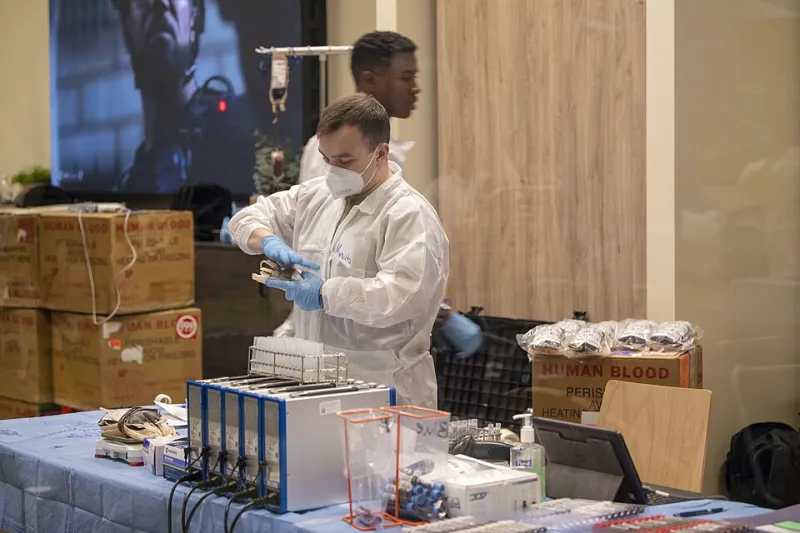
Photo: U.S. Air Force photo by Airman 1st Class Kendall Stuckman, Public domain, via Wikimedia Commons
A blood test feels like one event: a needle, a tube, a result. In practice it is a relay race run by people who rarely meet. The phlebotomist in a GP surgery, the porter navigating a hospital basement, the biomedical scientist loading a rack at six in the morning and the GP reading a screen before lunch are all links in the same chain. When a result is wrong, late or missing, the laboratory usually absorbs the criticism. Yet a substantial share of problems begin long before any sample reaches an analyser.
The invisible majority of errors
Laboratory medicine divides the testing process into three phases: preanalytical, analytical and postanalytical. The analytical phase — the chemistry happening inside the instrument — is the most tightly controlled, governed by calibration schedules, internal quality control and external quality assessment. The preanalytical phase, by contrast, is distributed across wards, clinics, portering teams and transport routes, and it is correspondingly harder to police.
That distribution matters. Successive reviews of laboratory error consistently attribute the majority of problems to the preanalytical phase, with commonly cited proportions in the region of two-thirds. In a UK context, where NHS England has spent the past decade consolidating hospital laboratories into larger pathology networks serving multiple sites, the distances involved have grown even as the analytical science has improved.
Before the needle touches skin
The chain begins with decisions taken in a consulting room. Is the patient fasting? Has a morning cortisol been booked for the afternoon? Has the patient been told to withhold biotin supplements, which can interfere with certain immunoassays? Has the correct tube — serum, lithium heparin, EDTA, fluoride oxalate — been selected for the requested assays?
Technique follows. Prolonged tourniquet time concentrates proteins and cells and can shift potassium and lactate. Draw order across multiple tubes affects additive carryover. Underfilled citrate tubes alter the blood-to-anticoagulant ratio and distort coagulation results. Vigorous shaking rather than gentle inversion lyses red cells, releasing potassium, lactate dehydrogenase and haemoglobin into the plasma.
None of these is exotic. All are routine.
The label is the sample
A tube without a reliable identity is not a sample; it is a hazard. UK laboratories operate a strict labelling standard, typically requiring handwritten or electronically captured identifiers taken at the bedside, with the collector's details and the time of collection. Samples arriving with a label written away from the patient, or with a single surname and no forename, are usually rejected outright.
Rejection rates are a useful but blunt metric. A rejected sample means a repeat venepuncture, a delayed decision and, occasionally, a patient discharged before the result is available. The more instructive figure is the near-miss rate: samples that were mislabelled but happened to be caught. Electronic collection systems, in which barcodes are scanned at the bedside and labels printed on demand, have reduced but not eliminated these events.
Movement, temperature and the limits of the air tube
Once labelled, a tube becomes logistics. In many trusts it travels by pneumatic air tube to a central reception area — fast, efficient and, for some assays, quietly damaging. Accelerative forces can cause haemolysis, and the problem is not evenly distributed: it rises with distance, with the number of carrier stations and with the fragility of the sample.
Temperature is the second variable. Most routine chemistry tolerates ambient conditions for a few hours; some tests do not. Ammonia, lactate, blood gases and certain coagulation assays deteriorate quickly and need ice or rapid delivery. A tube that sits on a reception bench while a batch is assembled is ageing in ways the requesting clinician cannot see.
Time-critical pathways — sepsis, suspected myocardial infarction, acute kidney injury — are built around turnaround time targets. Those targets are frequently measured from laboratory receipt, not from the moment of collection, which flatters performance and obscures the true delay experienced by the patient.
Centrifugation, interference and the analyser's silent judgement
Inside the laboratory, the sample is centrifuged to separate cells from plasma or serum. Incomplete clotting before spinning produces fibrin strands that can block aspirating probes. Lipaemic samples scatter light and interfere with photometric assays. Haemolysed samples release intracellular constituents that mimic disease.
Modern analysers report haemolysis, icterus and lipaemia indices alongside results, and these flags are the laboratory's way of saying the number may not mean what it appears to mean. Whether a flag reaches the clinician in a usable form depends entirely on the reporting interface — and on whether anyone reads it.
Quality control is not a formality
Every accredited laboratory in the UK works to ISO 15189, assessed by UKAS. Internal quality control is run daily and interpreted against defined rules; external quality assessment schemes compare performance with peer laboratories. Where a result conflicts with a previous one, delta checks trigger a review.
This machinery is what allows a laboratory to defend a result. It is also, inevitably, retrospective. Quality control validates the run; it does not validate the tube.
The release of a result
Results travel through laboratory information systems, increasingly alongside electronic requesting, into the Integrated Clinical Environment used by primary care and hospital teams. Critical results — a potassium of 7.0, a haemoglobin of 50 — are telephoned against a documented policy. Everything else appears silently.
Postanalytical failure is often a failure of attention rather than of technology: a result filed to the wrong encounter, an add-on test that was never requested, a cascade that stopped one step too early.
Where improvement actually happens
Three interventions recur in trusts that have reduced preanalytical harm. The first is data: routine audit of rejection reasons, haemolysis rates by collection area and turnaround time measured from collection rather than receipt. The second is feedback: sharing that data with the clinical teams who collect the samples, rather than with the laboratory alone. The third is design: barcode-enabled bedside labelling, dedicated portering for urgent work, and clear visual separation of time-critical specimens.
None of these requires a new analyser. All of them require someone to own the gap between the arm and the answer.
Questions worth asking
Does your network report turnaround time from collection or from receipt? What is the haemolysis rate for samples arriving by air tube, and does anyone discuss it with the wards? Which assays in your repertoire are genuinely time-sensitive, and does the transport route reflect that? And when a sample is rejected, does the patient find out before the clinician does?
The answers are unglamorous. They are also where the next improvement in diagnostic safety is most likely to come from.